

 Magyar

Health & Ergonomics
Light, Noise and Air: the Invisible Side of Office Ergonomics
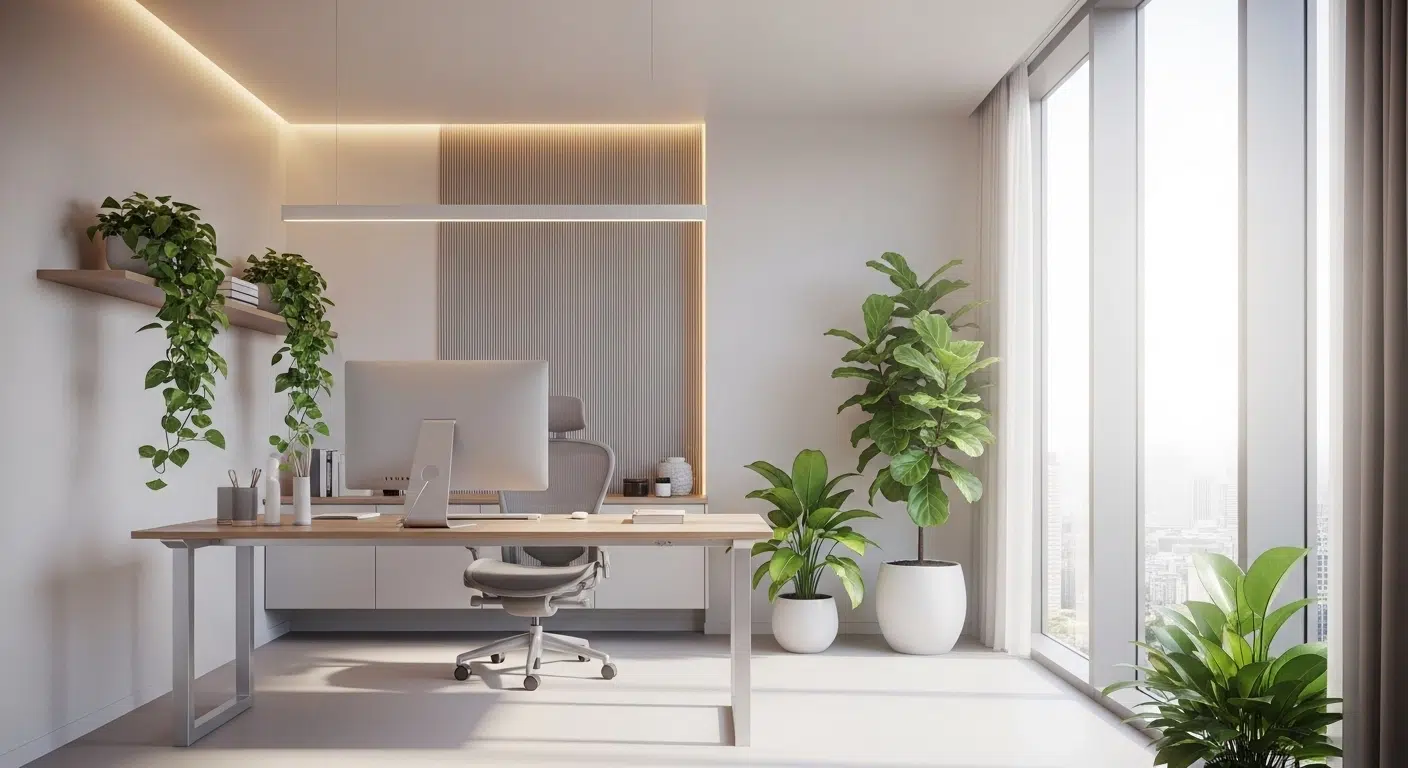
When we talk about office ergonomics, most of us think of a spine-friendly chair, a height-adjustable desk or a well-angled monitor arm. These really are the cornerstones of physical health. But what about the factors we can’t control that still fundamentally determine our performance?
Research shows that poor lighting, constant background noise and stale air can insidiously eat away at our concentration hour after hour. This is the invisible side of ergonomics. It’s no use sitting in the world’s most comfortable premium office chair if at 2pm high levels of carbon dioxide make your brain feel ‘foggy’ or the flickering fluorescent lights give you a headache. Let’s take a look at how to optimise these three critical areas.
1. Lighting and lighting conditions: the invisible burden of the eye
Our eyes are one of our most complex organs, and they are under the most strain in office work. Inadequate lighting (too much or too little) leads to constant, unnoticeable spasm of the eye muscle and eventually to chronic headaches.
The power of natural light and the risk of glare
The most ideal source of light is natural sunlight, as it regulates our circadian rhythm (our sleep-wake cycle). However, it does matter how it reaches our desk. The biggest mistake is to sit with your desk facing or with your back to the window. If we sit facing it, the bright light outside blinds us (glare). If you sit with your back to it, the light is reflected onto the screen, causing glare, so your eyes have to double focus to “see through” the glare.
The perfect arrangement: place the desk perpendicular to the window so that natural light comes in from the side, without glare or reflections.
Artificial lights: the Kelvin and Lux rule
If natural light is not enough, artificial lighting needs to be cleverly adjusted. You need to pay attention to two things:
- Colour Temperature (Kelvin): warm yellowish light (2700K – 3000K) is relaxing, perfect for the living room but relaxing in the office. For work, “natural white” (daylight) between 4000K – 5000K is best, because it keeps the brain alert.
- Light intensity (lux): the ideal illumination for a modern office desk surface is around 500 lux. Anything less than this and your eyes will squint, and anything more and your retinas will burn out.
2. Acoustic Ergonomics: noise as a constant source of stress
Noise is the biggest cancer of 21st century offices (especially “open office” layouts). The human brain is evolutionarily hardwired to react to any unexpected sound (e.g. a colleague’s loud phone call, a printer starting up) as a danger signal.
Did you know? According to research from the University of California, it takes an average of 23 minutes after a single distracting sound to return to a state of deep concentration, known as ‘flow’. That’s a loss of productivity measured in hours per day.
How to protect yourself from acoustic stress?
- Noise insulation in the space: hard surfaces (glass, concrete, laminate flooring) reflect sound waves, making the space echo. Use soft materials (thick carpets, acoustic wall panels, large-leaved houseplants) that absorb noise.
- The White Noise Trick: If you work at home and are disturbed by traffic or a neighbour outside, a softly humming fan or a white noise generator is the perfect way to block out distracting, shrill sounds.
- Noise-cancelling (ANC) headphones: one of the modern office worker’s most important “weapons” for staying focused.
3. Air Quality and Climate: the invisible fuel of the brain
Do you often feel exhausted between 2 and 3 in the afternoon, yawning and unable to compose a simple email? Before you go for that third coffee, check your breath!
The carbon dioxide (CO2) trap
In an enclosed room (especially with modern, well-insulated plastic windows), the level of carbon dioxide exhaled rises dramatically and rapidly. While the CO2 content of fresh air outside is around 400 ppm (parts per million), in a closed office it can quickly climb to over 1000-1500 ppm. This is when the “foggy brain” syndrome sets in, with headaches and a drastic deterioration in decision-making.
The solution is simple: combine the built-in timer of the most modern height-adjustable desks (which warns you to stand up) with a quick ritual: when the desk gives you the signal, stand up and open the window for 5 minutes to cross your legs!
Temperature and Biofilia
The ideal office temperature is between 21-22°C with 40-60% humidity. Any warmer than this and the body wastes energy on cooling. Also, don’t forget the principle of ‘biophilia’ (love of nature): the sight of green plants has been shown to reduce blood pressure and stress levels, while also improving (albeit minimally) the air quality in the room.
Summary: Plan the whole experience!
Ergonomics does not stop where your body comes into contact with the furniture. A healthy, spine-friendly workstation can only be 100% effective if the environment supports the focus. Ventilate regularly, adjust the monitor’s position in relation to natural light and eliminate distracting noise. If the environment and premium furniture are in harmony, you can get up from your desk at the end of the working day feeling fresh and pain-free.
Frequently Asked Questions (FAQ)
What colour temperature bulb should I use in my desk lamp?
For working, reading and focusing, 4000K (natural white) is the ideal colour temperature. This is bright enough to avoid eye fatigue, but not so blue that it interferes with melatonin production (like cool white lights above 6000K).
How can I avoid monitor glare if I can only place the desk next to a window?
If there is no other option, the most important thing is to have the table perpendicular to the window (so the light comes from the side). You may also want to install a roller blind or strip curtain that is translucent but blocks direct sunlight.
How often should you ventilate your office?
In enclosed spaces without artificial ventilation, it is recommended to open the window for 5-10 minutes every hour. This should be combined with active rest (when you get up from your desk and move your limbs).
Tetszett a cikk? Ne maradjon le a következőről!
Csatlakozzon az Ergomax közösséghez! Szakértői tippeket küldünk a hátfájás ellen, és elsőként értesítjük az exkluzív akciókról. Kezdje a fájdalommentes munkát még ma!